Amazon Strategy for Industrial Brands: 3 Costly Mistakes
Industrial and home improvement brands lose sales on Amazon due to 3 avoidable mistakes: no channel strategy, weak listings, and poor ad targeting. Here's how to fix them.
The 3 Biggest Mistakes Industrial & Home Improvement Brands Make on Amazon
(And How to Fix Them)
Introduction
Amazon represents a massive opportunity for industrial and home improvement brands—but it's not like selling consumer products. Many manufacturers jump onto the platform without a clear strategy, only to face channel conflict, poor conversion rates, and wasted ad spend.
The good news? These mistakes are entirely preventable. This guide breaks down the three most common pitfalls we see industrial brands make on Amazon and provides actionable solutions to overcome them.
Mistake #1: No Channel Strategy or Catalog Protections
The Problem
Many industrial brands arrive on Amazon without a clear plan for how the platform fits into their overall distribution strategy. This creates chaos across four key areas:
This image illustrates three major mistakes industrial brands often make on Amazon, emphasizing the need for strategic improvements to boost visibility and sales success.
No Definition of Amazon's Role
Is Amazon a direct sales channel? A discovery platform? A last-resort option for hard-to-find SKUs? Without clarity, you're setting yourself up for internal and external conflict.
Not Setting Pricing / MAP Policies
When you don't establish Minimum Advertised Pricing policies or consistent B2B pricing structures, your products end up in price wars that erode margins and damage brand perception.
No Distributor Alignment
Your distributors and dealers don't know the rules of engagement on Amazon, leading to confusion, resentment, and violation of pricing agreements.
Allowing Rogue Sellers
Unauthorized resellers flood your listings with inconsistent pricing, counterfeit products, and poor customer service—all under your brand name. This damages trust with both contractors and procurement teams.
The Result: Channel conflict erupts. Your traditional distribution partners feel undercut. Pricing becomes inconsistent across the platform. Your brand credibility suffers, and customers lose confidence in purchasing from you.
The Solution: Define Amazon's Role & Control Your Catalog
Develop a Clear Channel Strategy
Position Amazon as a supplemental channel, not a competing one. Frame it as a discovery and convenience tool that drives customers to your authorized dealers for complex purchases or ongoing relationships.
Map out where Amazon fits in the buyer journey. For many industrial buyers, Amazon is the starting point for research before they contact a distributor. Use this to your advantage.
Implement a MAP policy for all distributors and dealers and ensure Amazon pricing aligns with your policy. Make compliance non-negotiable.
Update distributor and dealer agreements to explicitly prohibit sales to Amazon resellers. This prevents your own partners from fueling the unauthorized seller problem.
Control Your Catalog Strategically
Create B2B-friendly SKUs specifically for Amazon. Consider offering case packs, contractor bundles, or unique configurations that don't directly compete with dealer-sold individual units.
Keep high-complexity products off the platform. Custom fabrication, made-to-order items, or products requiring professional installation may not belong on Amazon. Protect these for your dealer network.
Use custom listing strategies for multi-step purchases. For products that require consultation or customization, use Amazon as a lead generation tool that directs buyers to your dealers rather than attempting direct sales.
Mistake #2: Poorly Constructed Product Pages
The Problem
Industrial and home improvement buyers aren't browsing casually—they're researching, comparing, and making calculated purchasing decisions. When your product pages fail to provide the technical information they need, you lose the sale.
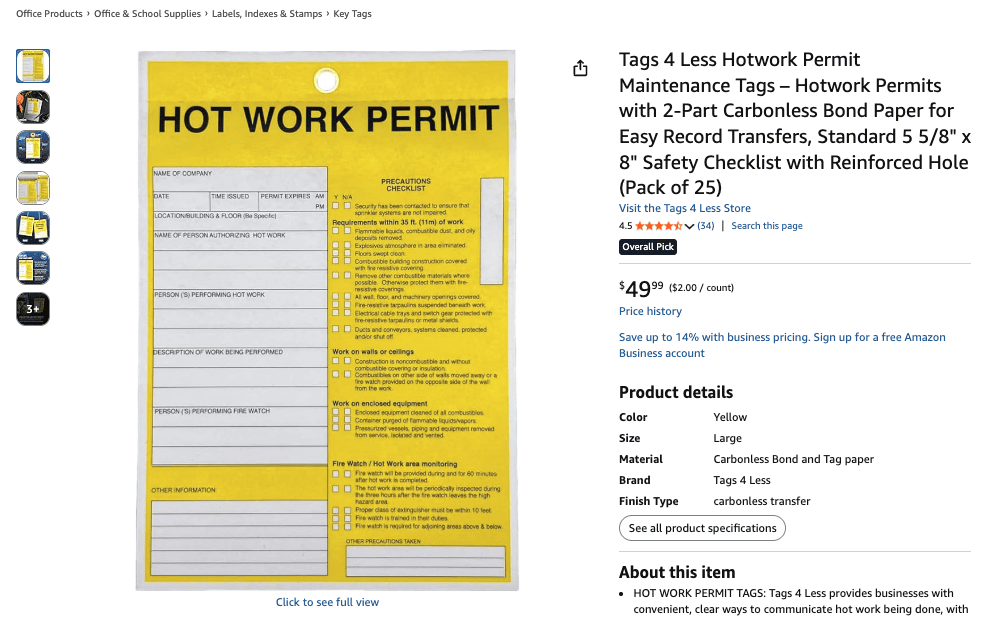
Industrial hot work permit sign highlighting safety zones and approval requirements for hot work activities in manufacturing environments.
Low-Quality Images – Blurry photos, poor lighting, or generic manufacturer images don't build confidence with professional buyers who need to see exactly what they're getting.
Missing Dimensional Drawings or Spec Sheets – Contractors and facility managers need precise measurements, load ratings, material specifications, and compatibility information. If it's not on the page, they move to your competitor.
No Comparison Charts – Business buyers are comparing multiple products simultaneously. Without clear comparison tools, you make their job harder and lose to brands that make decision-making easier.
Only Providing Information in Description – Amazon's A9 algorithm prioritizes content in titles, bullet points, and backend keywords. Burying critical information in paragraph descriptions means both the algorithm and buyers will miss it.
The Solution: Optimize Your Product Pages for Technical Buyers
Create Professional, Informative Imagery
Work permit sign for hot work safety, featuring clear instructions and compliance details for industrial safety management.
High-quality, clear images from multiple angles showing the product in use, close-ups of key features, and scale references
"What's Included" images that show all components, hardware, and accessories in the package
Infographic images displaying specifications, dimensions, weight capacity, and material composition
Comparison chart images showing how your product stacks up against competitor models
Structure Content for Discoverability and Conversion
Lead with specifications in bullet points: dimensions, materials, load capacity, certifications, and compatibility
Include technical details early: Don't bury critical specs at the bottom of the description
Highlight complementary products and bundles to increase average order value and provide complete solutions
Provide Decision-Making Tools
Create variation relationships for similar products (different sizes, finishes, or configurations). Use Amazon's comparison table feature to help buyers evaluate options side-by-side.
Include certification badges, compliance information, and industry standard references
Mistake #3: Neglecting Advertising
The Problem
Many industrial brands assume that if they list their products, business buyers will simply find them. This passive approach leaves massive revenue on the table.
Assuming Buyers "Will Just Find You"
Even well-known brands get buried in search results without active advertising. Business buyers search using specific technical terms and model numbers—if you're not bidding on these keywords, your competitors are.
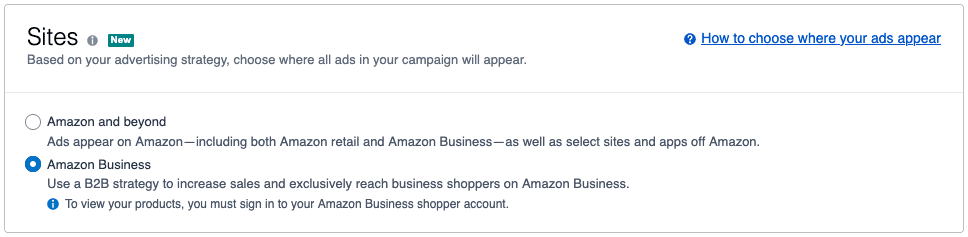
Not Using B2B Placements & Amazon Business Campaigns
Amazon offers specific targeting options for verified business customers, but most brands ignore these tools and waste budget on retail shoppers who aren't their ideal customers.
Not Factoring in Lower Weekend Demand
Industrial purchasing happens during business hours on weekdays. Running ads at full spend on Saturday nights wastes budget when procurement teams aren't actively shopping.
An informative graphic outlining three major mistakes industrial brands make on Amazon, essential for avoiding costly errors and improving Amazon marketplace success.
The Solution: Build a Strategic B2B Advertising Approach
Target the Right Keywords for Commercial Buyers
Technical and model-specific terms that professional buyers use versus consumer-friendly language
Category and competitor targeting to intercept buyers researching alternative solutions
Leverage Amazon Business Advertising Tools
Enable B2B placements on existing campaigns to specifically target verified Amazon Business customers
Create dedicated Amazon Business campaigns with messaging tailored to commercial buyers and procurement professionals
Test higher bids on B2B placements since these buyers typically have larger order values and better conversion rates
Use Product Targeting to show your products on competitor listings where business buyers are actively comparing options
Optimize for Business Buying Patterns
Implement day-parting strategies to reduce or pause ad spend during low-activity periods (evenings, weekends, Mondays); increase bids when procurement activity peaks
Monitor Business vs. Retail performance separately to allocate budget to the highest-returning customer segments
Track metrics beyond ROAS including average order value, repeat purchase rate, and B2B vs. retail conversion rates
Conclusion
The brands winning on Amazon in the industrial and home improvement space aren't just listing products—they're executing strategic channel plans, building conversion-optimized pages, and advertising intelligently to business buyers.
By addressing these three common mistakes, you can transform Amazon from a source of channel conflict and wasted resources into a powerful growth engine that complements your existing distribution network.
Ready to build a winning Amazon strategy for your industrial or home improvement brand? Contact us today
Read More Similar Articles
Jun 15, 2026
Amazon Shortening Product Title Character Limits
If you sell on Amazon, this one is worth a few minutes of your time. A title change is coming July 27, and if you're not prepared, Amazon will make the updates for you.
Amazon has added a percentage-of-sales fee to its Prime Day promotions for the first time. If your marketing team is planning deals without this in your models, the margin math is probably off.
Amazon Strategy for Industrial Brands: 3 Costly Mistakes
Industrial and home improvement brands lose sales on Amazon due to 3 avoidable mistakes: no channel strategy, weak listings, and poor ad targeting. Here's how to fix them.
Trustindex verifies that the original source of the review is Google.
I had a great experience speaking with Carolyn. She was incredibly positive, patient, and shared a lot of useful information about selling on Amazon Seller Central. She took the time to walk me through different strategies, explained how to improve discoverability, and even provided helpful keyword suggestions for my listings. I really appreciate how generous she was with her knowledge — you can tell she genuinely cares about helping sellers grow. Highly recommend connecting with Carolyn if you get the chance!
Posted on Google
Kristine Haldiman
Trustindex verifies that the original source of the review is Google.
We contacted ROI Swift to gain more insight into our Amazon storefront issues, and we were extremely impressed with this companies responsiveness, professionalism and wealth of knowledge in their field. Carolyn Lowe contacted us immediately after we reached out and really opened our eyes with solutions to our issues without any expectations. Her extensive knowledge was an enormous help to us and really showed how passionate and knowledgeable she is about her company and what it does and can do for businesses struggling to maneuver the marketing maze. We will be following her advise and look forward to seeing real results. With no hesitation, I highly recommend this company.
Posted on Google
Sophia Uhlenhoff
Trustindex verifies that the original source of the review is Google.
ROI Swift gives great marketing advice. Carolyn seems very knowledgeable about Amazon.
Posted on Google
Jon Paulsen
Trustindex verifies that the original source of the review is Google.
In a crowded landscape of paid search and paid social companies I found ROI Swift to be very knowledgeable in google, facebook, and Amazon paid ads. They patiently walked me through my particular online landscape and showed me where I could improve and how they can help. I'm a very satisfied customer now! I trust them and they've earned that trust.
Posted on Google
Ted Henry
Trustindex verifies that the original source of the review is Google.
Needing to promote two diverse product lines, and having little understanding of how to develop a presence for these products using Amazon Market Place, we needed professional guidance. We found ROISWIFT and Carolyn Lowe, CEO & Founder; a fortunate find it was. We presented Carolyn with our situation, our near term and out year's goals, and immediate needs. Carolyn was quick to assess our situation and to offer her superb experience based guidance about what must be done to reach our goals. Carolyn created two paths for us to follow. We are working those paths now. On ROISWIFT's Web site, ROISWIFT positions itself, when assisting clients, as ..."thinking like an owner;" for us Carolyn was more. She become a trusted guide offering her high intentions for our success, sincere effort, and intelligent direction. We are so pleased to have met her and ROISWIFT. You will be in superb hands working with Carolyn and the ROISWIFT associates. Theodore Henry REPCA Inc.
Posted on Google
John G. McGarvey
Trustindex verifies that the original source of the review is Google.
Excellent group! Carolyn and her team are thorough, strategic, resourceful and results oriented...and they deliver. I highly recommend ROI Swift!
Posted on Google
Ryan Bailey
Trustindex verifies that the original source of the review is Google.
ROI Swift was extremely helpful in helping me to optimize my Amazon PPC strategy! Extremely knowledgeable and professional staff that helped increase my ad conversion rates and bid optimization strategy! I recommend ROI Swift to other ecommerce sellers who are looking for support in getting their Amazon Seller Central business strategy optimized.
Posted on Google
Efri Dowek
Trustindex verifies that the original source of the review is Google.
Carolyn was great help super resourceful and knowledgeable - she put me on the right track or success and connected me with the right team
Posted on Google
Montana Flavor
Trustindex verifies that the original source of the review is Google.
Carolyn Lowe of ROI Swift was very helpful in assisting me on ways to grow my company. I look forward to working with her in the future.
Sign up for our monthly Profitable Amazon Growth Tips newsletter!